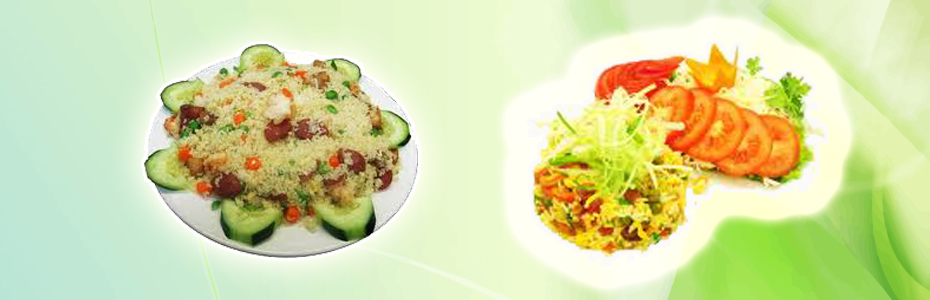
Rice dishes

Cơm chiên Dương Châu: A Chinese fried rice dish, named after the Yangzhou region in China. It is a well-known dish in Vietnam.

Noodle Soups

Phở: A noodle soup with a rich, clear broth made from a long boiling of meat and spices. There are many varieties of phở made with different meats (most commonly beef or chicken) along with beef meatballs.

Noodle dishes

Mì xào dòn: A dish of crispy deep-fried egg noodles, topped with a wide array of seafood, vegetables and shrimp in a gravy sauce. This is a dish of Chinese origin.

Soups and Cháo

Canh chua: Vietnamese sour soup - typically include fish, pineapples, tomatoes, herbs, beansprouts, tamarind, and various kinds of vegetables; when made in style of a hotpot, it is called Lẩu Canh Chua.

Meat dishes

Bò kho (Meat Soup): A beef and vegetable stew, often cooked with warm, spicy herbs and served very hot with French baguettes for dipping. In northern Vietnam, it is known as "bò sốt vang"

Thursday, March 29, 2012

Noodle soups

Bún bò Huế: Spicy beef noodle soup originated from the royal city of Huế in Central Vietnam. Beef bones, fermented shrimp paste, lemongrass, and dried chilies give the broth its distinctive flavors. Often served with mint leaves, bean sprouts, and lime wedges. Blood cakes and pig's feet are also common ingredients at some restaurants in the United States and possibly elsewhere.

Bún măng vịt: Bamboo shoots and duck noodle soup.

Bún Ốc: Vermicelli with snails (sea snails similar to the snails in French cuisine).

Bánh canh: A thick tapioca/rice noodle soup with a simple broth. Often includes pork, crab, chicken, shrimp, spring onions and freshly sautéed onions sprinkled on top.

Bún riêu: A noodle soup made of thin rice noodles and topped with crab and shrimp paste, served in a tomato-based broth and garnished with bean sprouts, prawn paste, herb leaves, water spinach, and chunks of tomato.

Mì bò viên: A Chinese-influenced egg noodle soup with beef meatballs and raw steak

Phở: A noodle soup with a rich, clear broth made from a long boiling of meat and spices. There are many varieties of phở made with different meats (most commonly beef or chicken) along with beef meatballs. Phở is typically served in bowls with spring onion, (in phở tai) slices of semi-cooked beef (to be cooked by the boiling hot broth), and broth. In the South, vegetables and various herbs are also added.

Phở satế: Spicy noodle soup with thinly sliced rare beef steak, satế hot chili sauce, sliced cucumber and tomatoes, and peanut.

Mì vįt tiềm: Yellow noodle soup with roasted duck and chinese broccoli.

Hủ Tiếu: A noodle soup with many varied styles including a 'dry' (non-soup but with sauce) version, brought to Vietnam by way of Chinese (Teochew) immigrants. The noodles are usually egg noodles or rice noodles, however, many other types may be used. The soup base is made of pork bones.

Noodle dishes

Bánh hỏi: An extremely thin noodle that is woven into intricate bundles. Often topped with spring onion and a complementary meat dish, such as thịt heo quay (roasted pork, often eaten at weddings). Also served with rice spring roll wrapper and beef, shrimp,Vietnamese ham (nem nướng), or ground shrimp (chạo tôm), and fresh vegetables.

Bún thịt nướng: A thin rice vermicelli served cold with grilled marinated pork chops and nước chấm (fish sauce, served with julienned daikon and carrot). A similar Northern version is bún chả with grilled pork meatballs in place of grilled pork chops.

Bún chả: Grilled pork (often grounded) and vermicelli noodles over salad, sliced cucumber, herbs and bean sprouts. Often includes a few chopped-up egg rolls, spring onions, and shrimp. Served with roasted peanuts on top and a small bowl of nước chấm. Egg rolls are often used as a substitute for the meat.

Cao lầu: A Hội An dish, made of specially "burnt-flavoured" egg noodles topped with meats.

Mì Quảng: A popular and extremely complicated noodle dish, originating from Quang Nam. Mi Quang varies in its preparation but features sharply contrasting flavors and textures in a shallow bowl of broth, noodles, herbs, vegetables, and roasted rice chips (bánh đa).

Mì xào dòn: A dish of crispy deep-fried egg noodles, topped with a wide array of seafood, vegetables and shrimp in a gravy sauce. This is a dish of Chinese origin.

Bánh tằm cà ri: A Cà Mau[disambiguation needed ] specialty, made of special rice noodles and very spicy chicken curry.

Hủ tiếu xào: A dish with flat rice noodles stir fried with mixed vegetables (sliced carrots, bell peppers, onion, broccoli, and snow pea) and with a combination of seafood, pork, chicken, or beef

Introduction about Pho Viet

Noodles tangling around every component unguarded. Meat simmering beneath a mixture of mouth-watering broth. Fresh herbs floating about. Squeezes of lime perking up the flavor of all ingredients. A bowl of Pho has to be just right Delicious Pho can be delicate or rich-tasting, spicy or subtle. Its success lies in a balance of well-made broth, noodles, beef and accents. It has to steam up against your glasses to ensure just the right temperature at the right time.

All the components are artfully arranged with bright chopped cilantro and scallions scattering on top. A separate plate filled with a grand variety of fresh basil, bean sprouts, slices of jalapeno, and a wedge or two of lime. Sriracha, hoisin and other sauces on the table are for personalizing your own broth or for dipping the meat.

Here at Pho Viet, in addition to Pho Bo, we feature other finest naturally flavored Pho noodles with low-calorie, delicious soups to give our customers a complete, nutritious and well-balanced meal. The beef Pho came from Hanoi, Vietnam and was influenced by French traditions. Some proposed the Pho was from the French feu (Fire), as in the classic boiled dinner pot-au-feu, which the French colonialists introduced to Vietnam.

 Pho is regarded as an everyday soup, which can be consumed at anytime during the day, by anyone of any social range or status. If it’s super hot outside, you could eat a steaming bowl of Pho for a sauna-like purge. If it's freezing cold and overcast, you could eat Pho to warm up. Pho is also known to be rich in vitamins and plays an important role in the staple diet, heath, and morale of the Vietnamese people.

Many of our customers have an obsession over our Pho Bo, the beef version. They tend to ask how our tasty broth is made while embracing Pho as a fast food meal. A well-made bowl is all about the broth, and that means simmering bones and meat for hours on end along with charred ginger and onions, star anise, cloves and other warm spices. Garnishing Pho is like putting together your own hamburger—you can have it your way. So, before putting any Pho into your mouth, add your own finishing touches. You can dunk your grand variety of basil, bean sprouts, and slices of jalapeno, into your steaming bowl of Pho with squeezes from a wedge or two of lime.

Then dive in with a two-handed approach: chopsticks in one hand to pick up the noodles, the soupspoon in the other to scoop up broth and other goodies. Hence it’s time to put your head down and start slurping with lips poised just inches above the bowl. And to top it all off, you can dip your meat in the Sriracha and Hoisin sauce to deepen the flavor. Enjoy your Pho here at Pho Viet and you’ll be par of a special culinary and cultural transformation. We are proud to serve you only the jewels of the Vietnamese cuisine.